
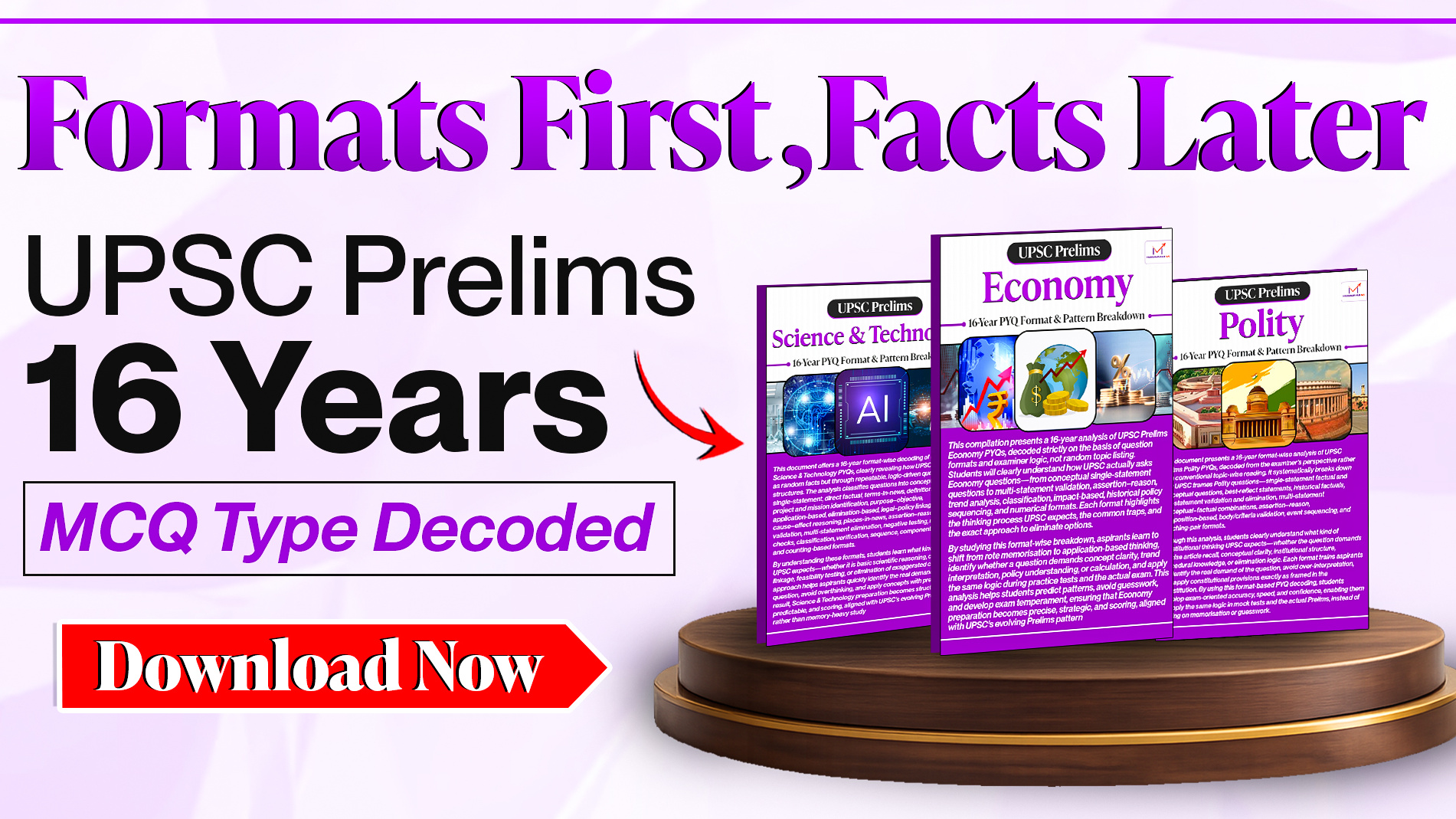
Inside UPSC Prelims: Subject Wise MCQ Formats Behind 16 Years (2010-2025)
Product information
- Number of chapters
- 2 Chapters
- Number of contents
- 10 Contents
Margdarshan IAS introduces a 16-year subject-wise decoding of UPSC Prelims MCQ types/Format revealing how UPSC repeatedly frames questions across Polity, Economy, Environment, Science & Tech, Security, IR, Schemes, and Geography. Aspirants learn formats, elimination logic, and examiner mindset to apply smart, exam-oriented preparation instead of random reading.
An aspirant who masters MCQ formats can handle new questions confidently, even from unfamiliar topics.
This is how preparation becomes time-efficient, strategic, and Prelims-ready.
What Should an Aspirant Learn from 16 Years of MCQ Types & Formats — and How to Apply It in Upcoming Prelims?
1. What an Aspirant Must Learn
By analysing MCQ types and formats across all subjects for the last 16 years, an aspirant should clearly learn that UPSC does not test syllabus coverage, it tests application through formats.
The key learning is to identify:
• Which MCQ format is being asked (single statement, multi-statement, pair, assertion–reason, extreme/negative, sequence, location, etc.)
• What kind of thinking the format demands — recall, elimination, logic, or map-based reasoning
• Where UPSC places traps — extreme words, partially correct statements, misleading pairings
This understanding shifts preparation from content accumulation to exam intelligence.
2. How to Apply This Methodology in Upcoming Prelims
Step 1: Read Every Question by Identifying the FORMAT first
Before reading options, ask: Which MCQ type is this?
Your brain immediately switches to the correct elimination logic.
Step 2: Prepare Subjects Format-Wise, Not Topic-Wise
While studying Polity, Economy, Environment, etc., practice:
• Multi-statement elimination
• Pair matching
• Negative and extreme statement handling
instead of only reading theory.
Step 3: Use PYQs to Practice Thinking, Not Memorisation
Re-solve PYQs by format, not by year.
This builds speed, accuracy, and confidence.
Step 4: Apply the Same Logic in Mock Tests
Treat mocks as format-recognition practice, not scorecards.