
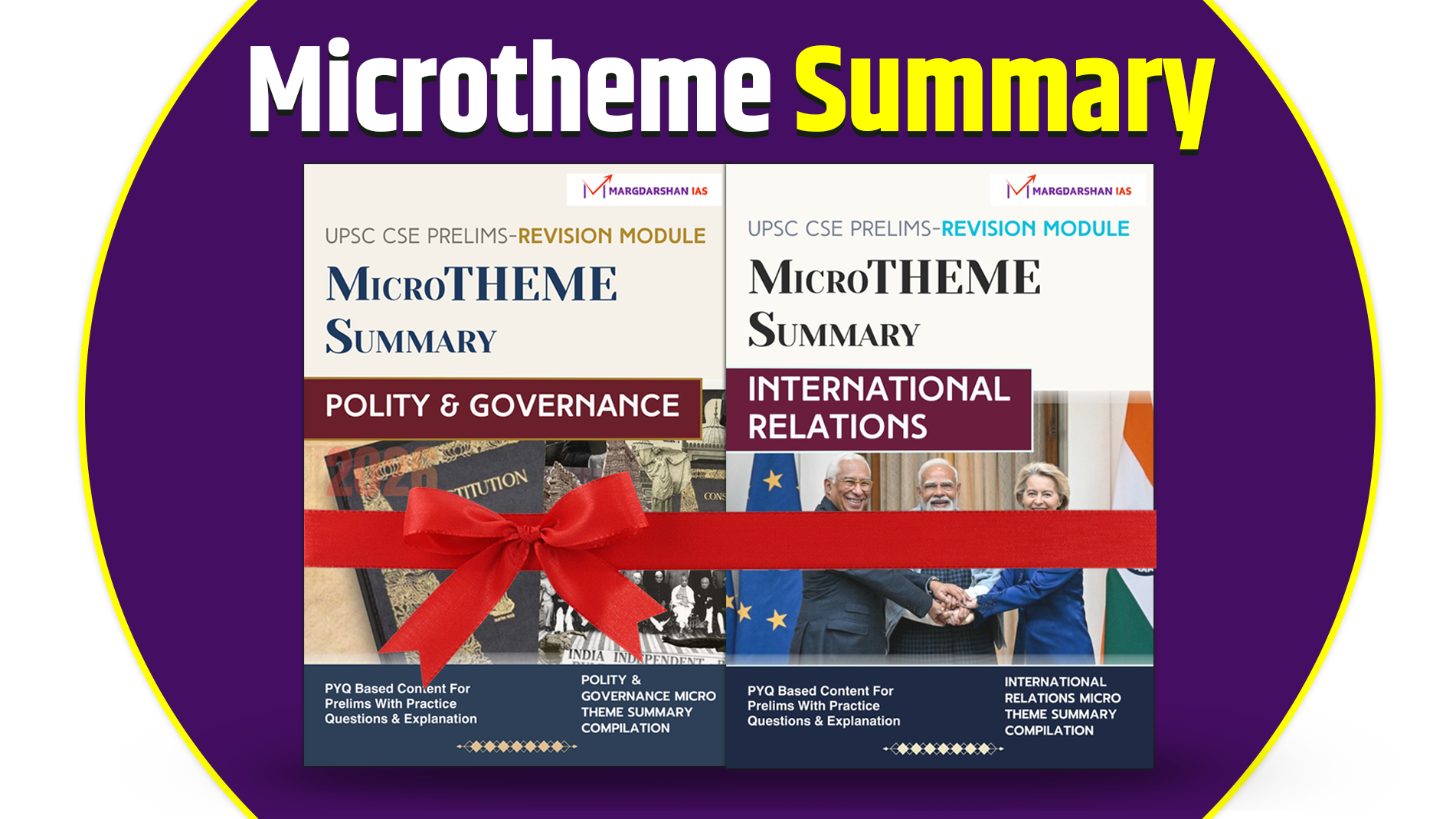
Polity and International Relations Prelims Microtheme Summary
Product information
- Number of chapters
- 2 Chapters
- Number of contents
- 3 Contents
Prelims MicroTheme Revision Compendium – Polity & International Relations
The Polity and International Relations section of the MicroTheme Revision Compendium is built from a systematic 16-year analysis of UPSC Prelims PYQs.
To my younger Brothers & Sisters, listen carefully.
You have studied the Constitution, revised standard books, followed current affairs, and solved PYQs. But as Prelims approaches, the real challenge is not lack of knowledge—it is confusion during revision, especially in Polity and International Relations where static concepts and current developments overlap.
That is exactly why we created this Polity & International Relations MicroTheme Revision Module.
First, we decoded 16 years of UPSC questions from Polity and International Relations. We analysed how UPSC frames statements on constitutional provisions, governance structures, rights, judiciary, and international organizations, treaties, and groupings. We identified recurring patterns, conceptual traps, and areas where static knowledge is linked with current affairs.
Then instead of adding more content, we converted everything into crisp, exam-oriented revision summaries—focused strictly on what UPSC repeatedly tests.
This module helps you identify high-priority areas, recurring themes, and evolving trends such as constitutional articles, federal structure, parliamentary procedures, global institutions, and India’s foreign policy engagements. It is designed with structured summaries, tables, and visual frameworks to ensure clarity and retention.
If you want clarity in topics like Fundamental Rights, Parliament, Judiciary, constitutional bodies, international organizations, and global groupings—this becomes your revision weapon.
At the end, we have provided FREE sectional MCQs so you can test whether your conceptual clarity is truly exam-ready.
Smart revision. Clear thinking. Calm confidence.
I am with you in this.
Key Features – Polity & International Relations MicroTheme Summary Book
1. 16 Years PYQ-Based Foundation (2010–2025):
- Built from UPSC questions on constitutional provisions, governance, and international relations.
- Focuses on repeatedly asked areas like Fundamental Rights, DPSPs, Parliament, Judiciary, and global organizations.
2. Theme → MicroTheme Structured Classification:
- Polity themes: Constitution, Fundamental Rights & Duties, Parliament, Executive, Judiciary, Federalism, Constitutional Bodies.
- International Relations themes: International Organizations, Global Groupings, Treaties & Agreements, India’s Foreign Policy.
- Further divided into microthemes such as Basic Structure, Amendments, Ordinances, WTO, UN Agencies, QUAD, etc.
3. Crisp, Revision-Oriented Summaries:
- Only exam-relevant provisions, articles, and concepts.
- Quick recall formats for constitutional articles, functions of bodies, and international institutions.
- Focus on statement-based clarity and elimination techniques.
4. Visual & Structured Presentation:
- Tables for comparison (e.g., Lok Sabha vs Rajya Sabha, Constitutional vs Statutory Bodies).
- Flowcharts for processes like law-making, constitutional amendment, and treaty mechanisms.
- Mind-maps linking static polity with current affairs in IR.
5. Subject-Wise Organized Modules:
- Integrated Polity and IR approach reflecting UPSC’s increasing trend of conceptual + current linkage.
- Coverage of both static (Constitution-based) and dynamic (current affairs-based) areas.
- Structured for quick and efficient revision before Prelims.
6. FREE Sectional Practice MCQs (with explanations):
- Polity MCQs on articles, institutions, and governance mechanisms.
- IR MCQs on organizations, groupings, and global developments.
- Detailed explanations to strengthen conceptual clarity and improve accuracy.